
How To Read This Site
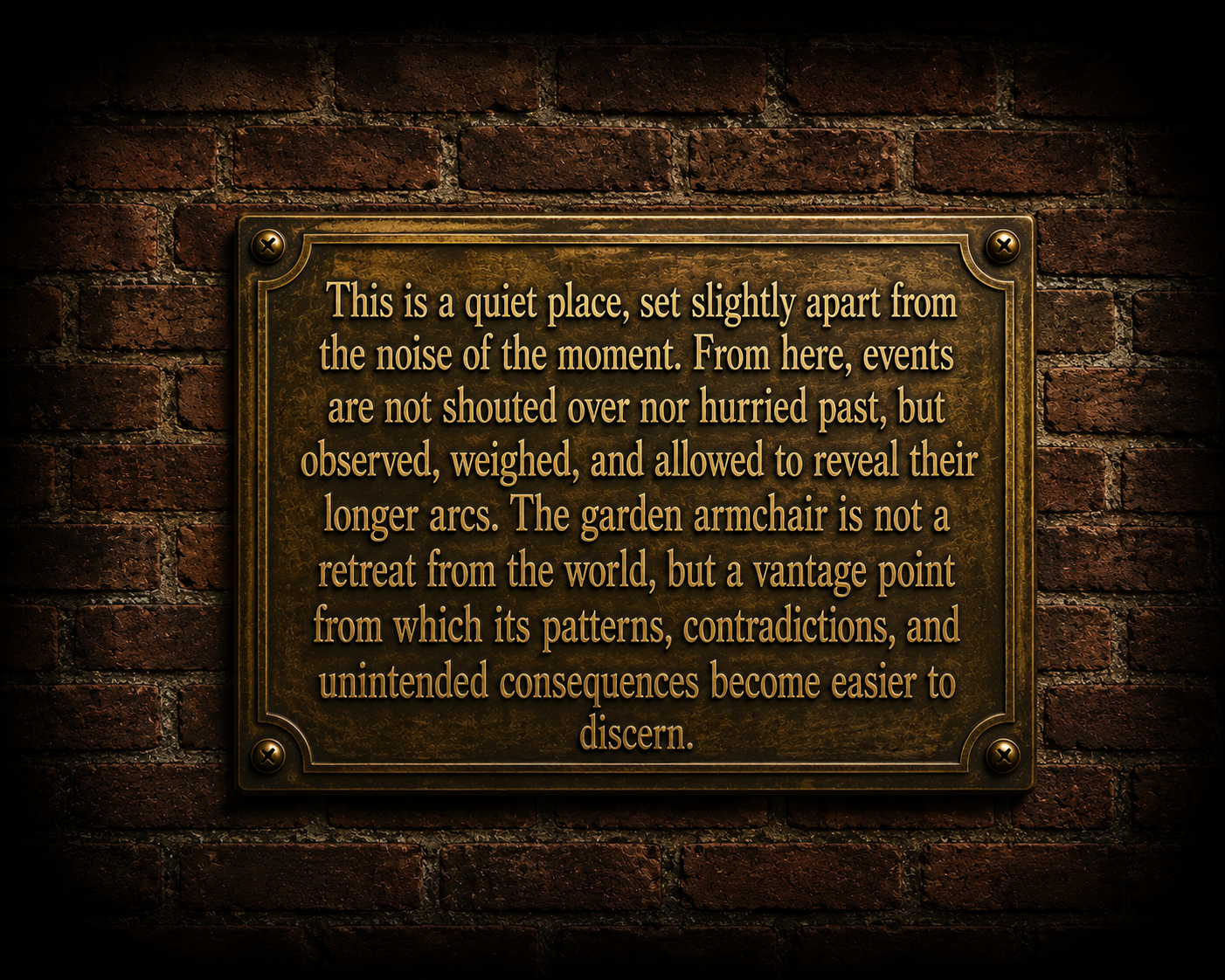
My Garden Armchair is not arranged for speed-reading, sloganising, or point-scoring. It is a place to follow an argument as it develops — to pause, reconsider, and test assumptions against context.
This short note is offered as a gentle guide to the spirit in which the site is written and the manner in which discussion is welcomed. It is not a set of rules so much as a statement of method: how to approach what is here, how to respond to it, and how to keep the conversation worth having.
Finding Your Way Around
The primary menu at the top of the site is not merely a navigation convenience. It reflects the way the site itself is organised.
- Home returns the reader to the main entry point.
- How To Read This Site provides this orientation.
- Discussion Themes gathers broader areas of reflection.
- Discussion Series contains structured sequences of essays where a subject is allowed to unfold over time.
- Video Playlists offers selected media for slower listening and reflection.
- Quotes and Quips provides shorter observations, fragments, and provocations.
- Legal Notices contains the formal information required for the responsible operation of the site.
In this sense, the menu should be read as a map. It is there to help the reader choose not merely where to go next, but what kind of engagement the next section invites.
Navigating the Site on Larger Screens
On larger screens, the site makes use of the sidebar as an orientation aid. The sidebar is not merely decorative. It helps display the broader section, series, or library within which the current item belongs.
This means that readers can usually see related material while reading the article itself. In this way, the sidebar functions as a guide, allowing the reader to move between connected items without losing sight of the structure surrounding the current page.
The same principle applies to the Reflection Panel. On larger screens, a note or launcher may appear in the sidebar, allowing the reader to pause, record a thought, and return to the article without being taken away from the reading experience.
The purpose is to keep navigation and reflection close to the text, so that reading, reconsidering, and exploring related material remain part of the same experience.
Navigating the Site on Smartphones
The majority of visitors now browse websites using smartphones rather than desktop computers. On larger screens, navigation aids appear in the sidebar. On a smartphone, however, that space is unavailable.
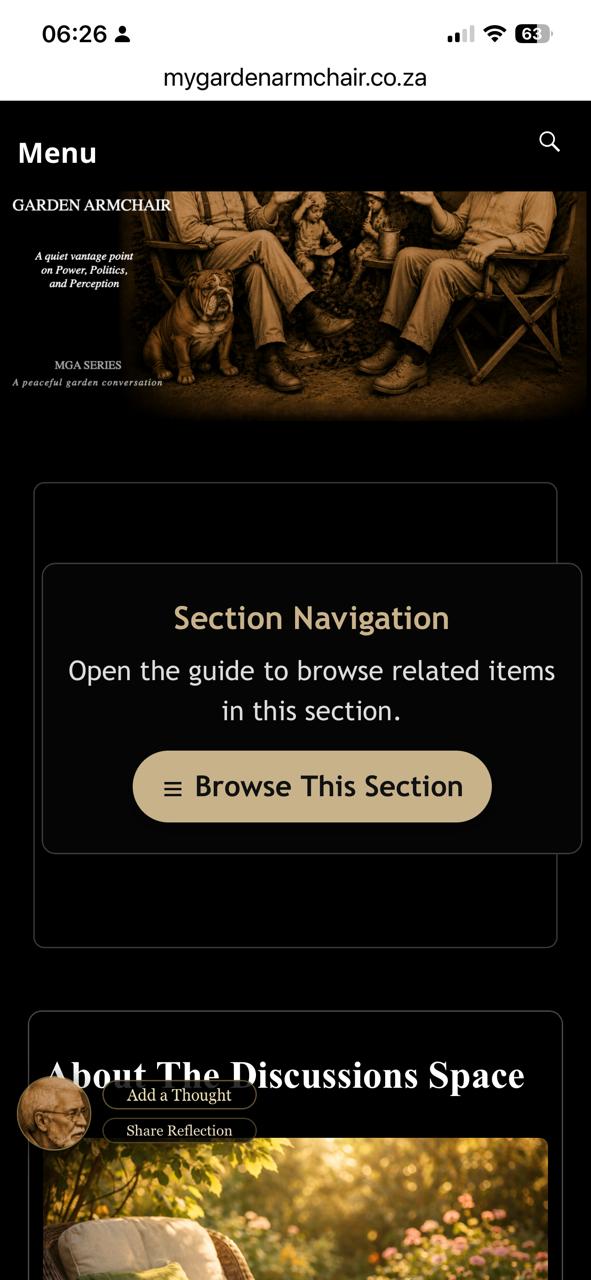
To ensure that mobile visitors can still navigate easily, a Section Navigation panel appears near the top of the screen.
Selecting Browse This Section opens a guide showing the material available within the area you are currently exploring.
The purpose of the guide is not merely to provide links. It helps visitors understand how the content is organised and reveals related material that might otherwise remain undiscovered.
Understanding the Section Guide
The Section Guide presents information in two layers. The upper panel displays the broader collection or library to which the current item belongs. The lower panel displays the content available within the specific subject being viewed.
This approach allows visitors to move easily between related subjects while retaining a sense of where they are within the overall structure of the site.
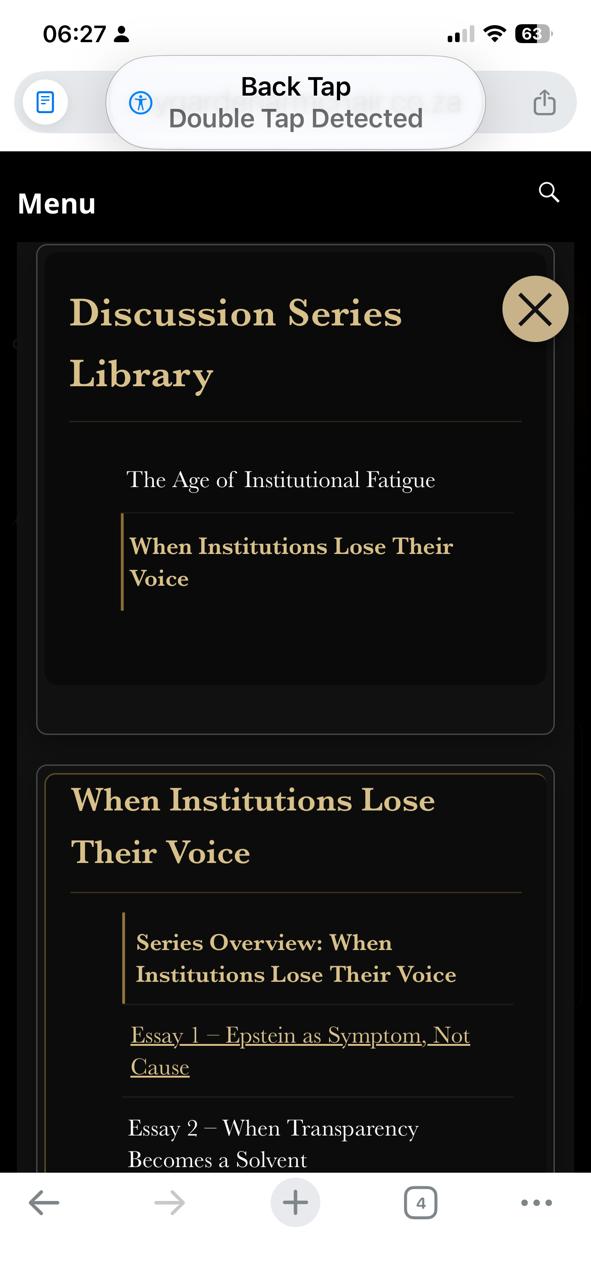
The Reflection Panel is also adapted for smartphone use. Instead of occupying a sidebar, it appears as a compact floating prompt. Selecting it opens the reflection space without requiring the reader to leave the page.
In this way, the phone version preserves the same intention as the desktop version: the reader can navigate, pause, reflect, and return to the article without losing the thread of the discussion.
Reading Beyond Headlines
Much of modern discourse is shaped by compression. Complex matters are condensed into headlines, slogans, clips, and fragments detached from the conditions that gave rise to them. The result is often reaction without orientation — opinion formed before context has had time to breathe.
This site attempts to move in the opposite direction. Articles and discussion series are therefore designed to unfold progressively. A thought introduced in one paragraph may only reveal its true significance several sections later. Some essays intentionally revisit earlier ideas from different angles, not to repeat them, but to expose how meaning changes when context changes.
Readers are encouraged to resist the temptation to skim for conclusions alone. Often the value lies not merely in the destination, but in observing how one arrives there.
The Reflection Panel
Throughout the site you may encounter the Reflection Panel. It was introduced for a simple reason: meaningful discussion is often lost because thoughts disappear before they can mature.
Modern online interaction encourages immediacy — instant reaction, rapid judgement, and the pressure to respond before one has fully considered the implications of what has been read. The Reflection Panel exists to slow that process down.
Rather than functioning as a public comment system driven by visibility, approval, or confrontation, the panel is intended as a private working space for thought.
Although the panel may appear differently depending on the device being used, its purpose remains the same: to create a place where reflection may develop before it disappears beneath the pace of modern discourse.
Readers may use the Reflection Panel to:
- Record immediate impressions before they fade.
- Note questions, contradictions, or emerging patterns.
- Capture quotations or ideas worth revisiting later.
- Test personal assumptions against the argument being presented.
- Develop a response gradually rather than react impulsively.
In many respects, the Reflection Panel serves the same purpose as the margin notes one might make while reading a book — a place where thought becomes visible to oneself before it is presented to others.
The panel is therefore not merely a technical feature. It forms part of the broader philosophy of the site: that careful reflection is becoming increasingly difficult in an environment dominated by acceleration, outrage, and informational overload.
Should a passing thought begin to take clearer shape, readers may choose to select “Share Reflection”, allowing the note to appear within the broader discussion space where it may later be expanded upon, revisited, or shared with others. In this way, a private reflection may, when appropriate, become part of a wider conversation rather than disappear unnoticed.
PLEASE FEEL FREE TO TEST THE PANELS
Discussion Themes and Series
Many topics on the site are arranged into structured discussion series rather than isolated articles. This is deliberate.
Certain subjects — institutional fatigue, technology, artificial intelligence, organisational behaviour, governance, social fragmentation, and similar themes — cannot easily be reduced to single essays without losing depth or continuity.
The series structure allows ideas to evolve over time, much as discussions do in real life. Readers may therefore find it useful to begin with the introductory overview pages, where the broader context and progression of the series are outlined.
A Final Thought
This site does not seek agreement for its own sake. Nor is it constructed around ideological camps, political performance, or algorithmic visibility.
Its purpose is simpler: to create a space where complex matters may still be approached with patience, context, proportion, and reflection.
“A thought before it passes.”
Reflection Corner
How To Read This Site — No Comments
HTML tags allowed in your comment: <a href="" title=""> <abbr title=""> <acronym title=""> <b> <blockquote cite=""> <cite> <code> <del datetime=""> <em> <i> <q cite=""> <s> <strike> <strong>