
Euphonium
The Euphonium — The Singing Centre of the Brass Ensemble
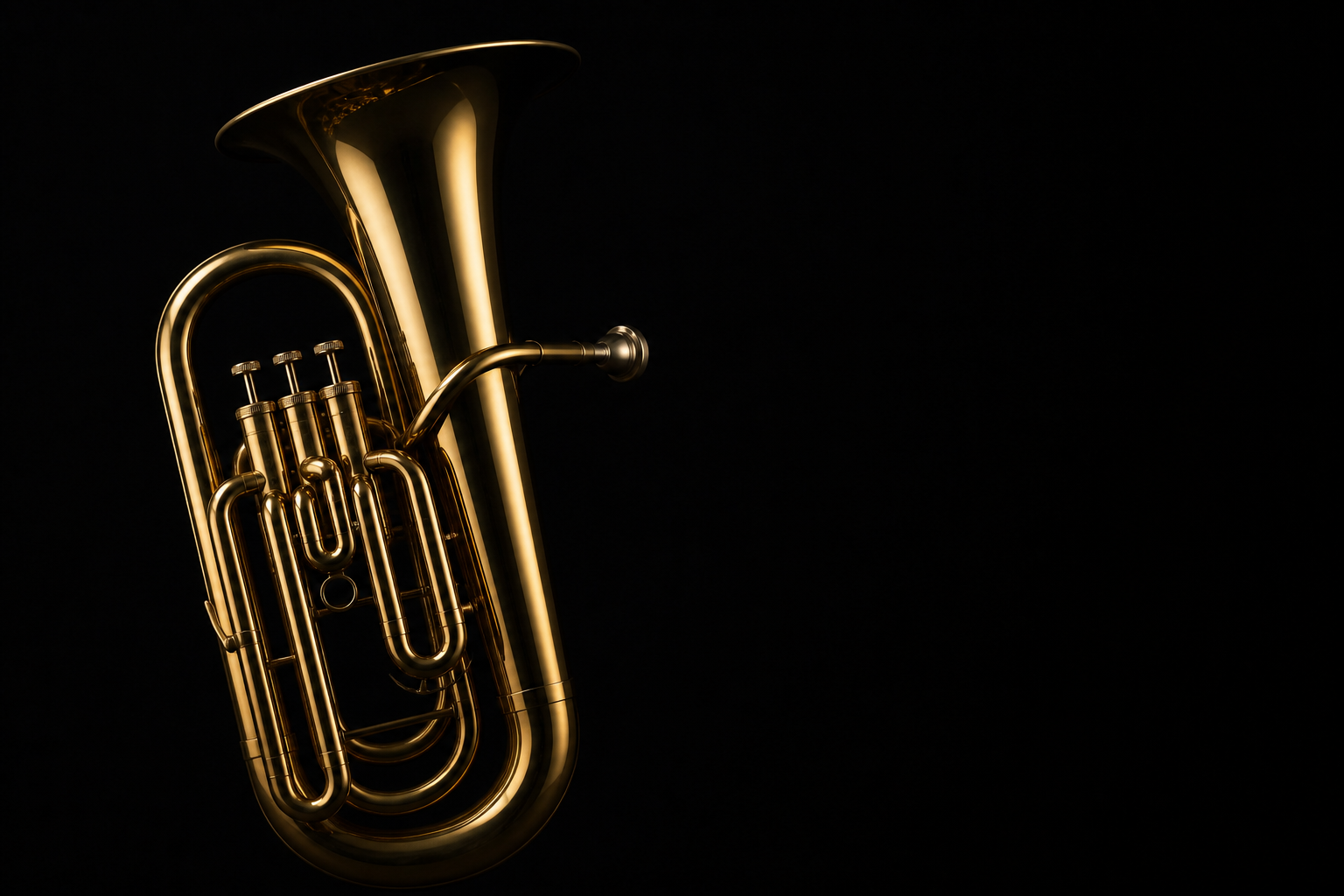
The euphonium is one of those instruments whose importance is felt long before it is consciously recognised. Neither ostentatious nor foundational, it occupies the emotional and tonal centre of the brass ensemble, shaping, softening, and giving voice to musical ideas that would otherwise feel incomplete.
Origins Shaped by Necessity
The euphonium emerged in the middle of the nineteenth century, at a time when brass instruments were undergoing profound transformation. Improvements in valve technology freed brass players from the limitations of natural harmonic series, allowing fully chromatic playing for the first time. Yet this technical progress exposed a gap within ensembles: there was no instrument capable of providing a lyrical, agile tenor–bass voice with warmth and expressive depth.
Earlier solutions — such as the ophicleide and various bass horns — offered partial answers but suffered from uneven tone, mechanical complexity, or limited projection. The euphonium evolved in response to these shortcomings. Its name, derived from Greek roots meaning “sweet-sounding”, reflects a tonal ideal rather than a mere description of range.
By the latter half of the nineteenth century, the euphonium had stabilised in its modern form: a conical-bore instrument, most commonly pitched in B♭, capable of both vocal lyricism and technical fluency.
Tone, Design, and Character
What distinguishes the euphonium is not simply its register, but its sound. The conical bore produces a tone that is rounded, warm, and enveloping — less directional than a trombone, less weighty than a tuba, yet unmistakably rich.
This tonal character allows the euphonium to function in multiple roles: as a principal melodic voice, as a harmonic anchor within the ensemble, and as a bridge between brighter upper brass and darker lower voices. It is an instrument that can lead without dominating, and support without disappearing.
The Brass Band Tradition
The euphonium found its most complete expression in the British brass band movement. As brass bands matured into disciplined, highly expressive ensembles, the euphonium assumed a role comparable to that of the cello in an orchestra — carrying extended melodic lines, providing emotional continuity, and often serving as the primary solo voice.
Composers quickly recognised its expressive potential. Euphonium parts grew increasingly demanding, requiring exceptional breath control, seamless legato, and technical agility. In this setting, the instrument ceased to be merely supportive and emerged as a true soloist.
Beyond the Brass Band
Although closely associated with brass bands, the euphonium’s reach extends well beyond them. In military and wind bands it fulfils a similar integrative role, softening the ensemble’s mid-range and adding warmth to melodic passages. Contemporary composers have increasingly written specifically for the instrument, exploiting its capacity for sustained lyrical expression and nuanced colour.
Its limited presence in the symphony orchestra is largely historical rather than musical. Orchestral instrumentation was already well established by the time the euphonium reached maturity. When composers do call for a “tenor tuba”, the part is frequently performed on euphonium in practice — a quiet acknowledgement of its suitability.
Repertoire and Modern Standing
For much of its early life, euphonium repertoire consisted of transcriptions and ensemble writing. The latter half of the twentieth century marked a turning point, with the emergence of a substantial body of original solo works demanding not only technical proficiency, but a distinctly vocal approach to phrasing and tone.
Today, the euphonium is taught as a primary instrument in conservatories and universities worldwide. Its solo repertoire continues to expand, and its standing as a legitimate concert instrument is firmly established.
A Quiet Authority
The euphonium’s significance lies not in spectacle, but in coherence. It binds sections together, moderates extremes, and gives musical ideas emotional weight without excess. Where brilliance can become brittle and power overwhelming, the euphonium restores balance.
In an age that often equates impact with volume, the euphonium stands as a reminder that authority — in music as elsewhere — can be exercised through warmth, restraint, and clarity of purpose.
Notable Euphonium Artists
The euphonium’s expressive potential is most clearly revealed through those who have mastered its voice. The following artists exemplify the instrument’s lyrical authority and technical refinement.